Once European Champions, Hamburger SV now are happy to be back playing Bundesliga football after seven years away. The ambition and history of the club-and the city-reach far beyond the docks of Germany’s famed northern port. This article is the second of a three part longread, written by History Educator and Football Traveller Ian Wolff.
Hamburger SV would be one of the founding members of the 1963 Bundesliga, but would wait sixteen years for their first title in the new division. Led by conditioning fanatic and former speedy fullback Branko Zebec as manager, they were anchored by a defence of centre-back Peter Nogly and Manfred “Manni” Kanltz, whose “banana” crosses would launch him to fame despite him only providing only two assists that season. In midfield, the deep-lying yet double-digit goalscoring Jimmy Hartwig, and the ever-entertaining Felix Magath linked with an attack which included the aforementioned Liverpool hero Keegan. Keegan’s arrival at Hamburg before the previous season had led to the departure of popular three-time European Cup winner Horst Blankenburg, who had just won the European Cup Winners Cup with HSV.
Trail of Blood
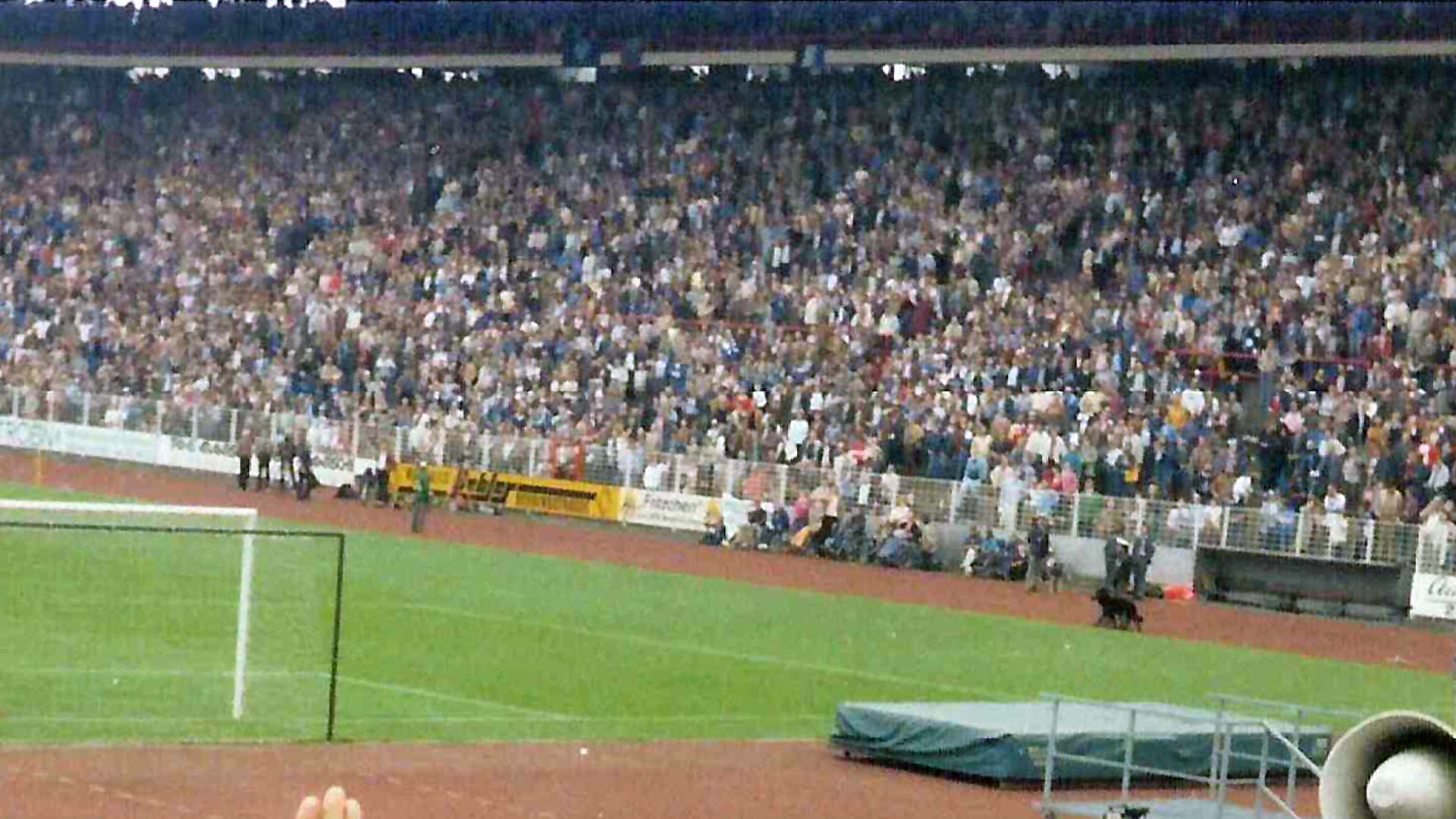
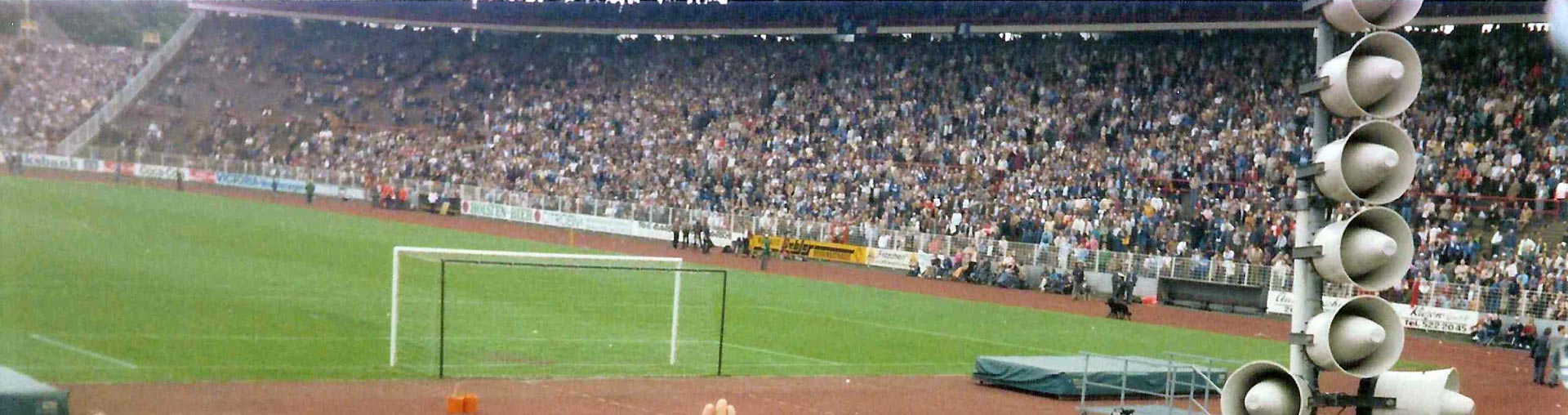
Keegan would be forgiven for instigating this departure. He would win football’s greatest individual honour, the Ballon d’Or, in both the 1977-78 and 1978-79 seasons, and help the club commonly referred to as “der Dinosaurier” (“the Dinosaur”) in reference to its size, and the length of time it had been since they had last been crowned Germany’s champions in 1960, to the 1979 German title. This would nearly cause a tragedy. During the last match of the season against Bayern Munich, overcrowding in Block E at the Volksparkstadion combined with intense excitement at the thought of the club becoming champions of Germany for the first time in two decades, and fans began to tear a whole through the fence and barbed wire separating them from the running track. As more and more supporters pushed their way through a small hole in the fence, the forthcoming human avalanche would leave 71 people injured, and four needing intensive care. This incident, referred to as having produced a “trail of blood”, would not be forgotten by the club, but would also not be allowed to cast a shadow over HSV’s triumph, or Keegan’s own personal memories.
He would reflect on his time at Hamburg in the following manner:
“Manni Kaltz was one of the five best footballers I ever played with, with his brilliantly whipped in crosses from the right, and Felix Magath was a prompting force from midfield. The fitness levels demanded by (manager) (Branko) Zebec paid off. While other teams were tiring towards the end of the season, we went on a run of nine wins from ten games. We didn’t look back after beating leaders Kaiserslautern, and when we reached the top we stayed there, until everything was confirmed with a game to spare. I was champion of Germany, scoring seventeen league goals in the process. Fantastisch”!
He would later describe the celebratory parade.
“…we stood in open top jeeps as we were driven to the Rathausmarkt, the main square, to show off the championship shield from the town hall. It was a great day for me, and, it seemed, the entire city”.
The next season almost brought greater triumph, however, as Hamburger SV were denied their first title as Champions of Europe by Brian Clough’s Nottingham Forest and the brilliant goalkeeping of Peter Shilton, having 24 shots while conceding only one[6]. Three years later, however, they would once again find themselves on the cusp of European glory-and this time, it would not be allowed to slip from their grasp.
“Had to be…Had to be…”
The story truly begins in January of 1982, when, down by 2 goals to Borussia Dortmund, three unanswered set-piece goals gave Hamburg a win that would be the first of thirty-six straight! Horst Hrubesch, a 6 ft. 2 inch (1.88 m) target man known-affectionately-as “Das Kopfball-Ungeheuer” (“The Header Beast”), signed before the 1978-1979 title season, would contribute an astonishing twenty-seven goals over that period. Felix Magath continued to have a creative and forceful impact in midfield, and Keegan’s 1980 departure had been followed by the arrival of another two-time Ballon d’Or winner, Franz Beckenbaur, who would leave the club at the end of the season after helping Hamburg secure their second title in four seasons. Hamburg’s unbeaten run would not come to an end with him, however, as it took until January of 1983 when, painfully, rivals Werder Bremen, led by famed marksmen Rudi Voller, would defeat HSV 3-2 at the Weser Stadium. The disappointment at losing such an incredible run of form to their rival port from the south west would fade, however, as the spring would greet those who lived on the banks of the Elbe with wins in the European Cup Quarter Final against Dynamo Kyiv and in the Semi-Final against Real Sociedad, creating a chance to claim the ultimate honour in European football that they had been so close to only three years earlier.
With memories of their defeat to Nottingham Forest still fresh, Die Rothosen (red shorts) would have to conquer northern Italian giants Juventus, whose ranks included unscrupulous and unforgiving defender Claudio Gentile, attacking midfielder Michel Platini, who that season would win the first of three consecutive Ballon d’Or awards, and striker Zbigniew Boniek, commonly considered the greatest Polish footballer to ever live. They were the underdog, and they knew it. This collection of characters, however, was undeterred.
“The main characteristic was that we had many players in the team who couldn’t stand losing, like me or Uli Stein, for example,” Magath would later recollect. Austrian manager Ernst Happel, a gambling, brandy-loving, chain-smoking curmudgeon who once famously told the media “write what you want. I don’t care anyway”, had drawn up a plan to bring the game directly to Juventus, which included relentless pressing, zonal marking, a precise offside trap, and his own brand of attaching advice. “Men, when we have the ball, the place has to be buzzing. Things had to get going”.
Wearing an all-red kit, only six of the team that had come so close three years before posed for the team photograph before kick-off in Athens. As the game began, both sides came close through headed chances, before Felix Magath would collect the ball on the left in the ninth minute. He casually took a first touch, then, with his second, sent Juventus winger Roberto Bettega jumping high into the air in anticipation of a shot. Upon landing, Bettega would find that the German wizard had gone well past him and taken a quick third touch before legendary left footed strike that evaded an oncoming slide tackle and talismanic goalkeeper Dino Zoff before nestling in the top corner. The European Cup was almost in their grasp-but almost wasn’t good enough. Not for Magath, not for Kaltz, and not for those who had followed their beloved HSV to the Greek capital. If the site of arguably history’s most important trading port was, on this night, to become where the club which represented the cradle of the Hanseatic League would claim one of Europe’s most sought-after prizes, it was going to be taken, not waited upon.
True to form, Magath continued to cause havoc down HSV’s left side, with the bianconeri of Turin struggling to live with his pace and exquisite ball control. As the game approached the 14th minute, Magath was fouled on the edge of the box, creating a set piece opportunity which was beautifully half-volleyed toward the far post by Manni Kalz, only to be cleared off the line by Polish legend Boniek. Boniek’ signature dribbling ability would be on display as Juventus would attempt to amount a response. Juventus left-back Antonio Cabrini would try his luck on either side of the half, including a free kick which went just over the bar. Their efforts would be matched blow for blow by the brilliance of Magath, who would come close to scoring multiple times with gorgeous control followed by left-footed strikes which displayed his technical brilliance.
As the game reached the closing stage, Massimo Bonini played a ball over the top which French legend Michel Platini got to before Hamburg goalkeeper Uli Stein. Platini tipped upwards over Stein before the two came together, and the Juventus man fell to the ground. Stein caught the ball whilst falling to the ground, and as he looked up, Platini’s arms were already outstretched, appealing for a penalty. HSV heart’s stopped beating. Platini’s, however, clearly thundered as he raced toward the referee to protest. “And the Juventus players are howling for a penalty” described Barry Davies, providing English commentary for the BBC. “Platini goes off and chases the referee”…As replays began to be shown, Davies would make his own feelings known about the incident. “Ah, had to be…had to be”.
Conquering Europe
But it was not to be for Juventus. Hamburger SV would continue to pile forward, with Jurgen Groh and Magath missing well-worked chances before the final whistle finally blew, and victory was confirmed. “Juventus, for sure, will talk about the penalty that wasn’t given” commented Davies for the BBC. “But in their heart of hearts, they must know that they were very much the poorer of the sides in the first half, and only showed glimpses of their form early in the second half”[11]. Analysis, however, was long since irrelevant for HSV. This was their European Cup the first time to be won by a West German club other than Bayern Munich, and vindication after coming so close three years earlier. They had worked harder, played better, and earned their triumph. As target man Horst Hrubesch and centre half Ditmar Jacobs grasped the trophy and held it aloft, they waved to the supporters of HSV who had made their way from one historical city by the sea to another. Those supporters acknowledged them in return, waving scarves, cheering wildly, and sharing the same opinion regarding the events of that night in Athens. It simply had to be.
The season was not over, however. Only three days later, a difficult test against Borussia Dortmund would be pivotal in deciding the destination of the German title, which was being fiercely contested by none other than rivals Werder Bremen. A 5-0 victory at the Volkparkstadion in front of 51,000 was followed by a 1-2 triumph away to Schalke, and HSV had secured a double. The ghosts of past failures had been well and truly banished.
The Rathausmarkt would welcome home its dual champions, providing an approving gaze as it looked down upon the blue, white, and blue diamonds of northern Germany. As the double triumph of northern Germany’s giant dinosaur confirmed, it was unthinkable that the club would go on to experience relegation before seeing another German title.
“The Dinosaur is Extinct”
Apart from the DFB-Pokal Cup in 1987 (and a preseason DFB-LigaPokal cup victory in 2003), this would be the most recent time Hamburger SV would win a major honour. Legends came and went, with names such as Tony Yeboah, Rafael Van der Vaart, Ruud van Nistelrooy, and Thomas Doll (as both a player and a coach) representing HSV over the years. Glory at times appeared close, such as in the 2010 Europa League semi-finals, where a painful 2-1 loss to Fulham prevented the club from playing in the final at the Volkparkstadion, and there were certainly memorable moments, such as Hakan Calhanoglu’s mind-boggling forty-one metre free kick against Dortmund in February of 2014. However, the most memorable moment for the current generation is almost certainly an unhappy one, which was recognised all across the footballing world in the early summer of 2018.
Hamburger SV had long been proud of being, since 1998, the only club to have never been relegated from the Bundesliga since its founding, and having played in Germany’s highest division continually since 1919[12]. Whilst HSV had been narrowly avowing relegation for much of the previous half-decade, they were still unwilling to believe that they would ever have to witness football in Germany’s second tier. The club finished 14th in 2017, and 16th in both 2015 and 2014, narrowly surviving the relegation playoffs against Karlsruher SC in 2015, and clinging to their Bundesliga status only through the away-goals rule against SpVgg Greuther Furth in 2014.
This did nothing to diminish the horror that came with the realisation of football in 2. Bundesliga for the first time since the Bundesliga’s 1963 formation. This hallmark was almost as important to HSV as their 1983 double, and had been commemorated with a digital clock installed in 2001 that tracked, to the second, how long Hamburger SV had been a Bundesliga club. As the whistle blew to end the club’s final match of the season against Borussia Monchengladbach, HSV now knew the clock would now have to be removed. For the thousands of supporters-and quite a few players-who could not hold back tears on 12 May, 2018, time had literally come to a terrifying standstill. “The dinosaur is extinct”[13], commented the English language media of the Bundesliga, recalling the long-held nickname of HSV.
The 57,000 fans in attendance looked at the clock, waiting for it to stop, but it carried on defiantly as tears began to flow ever more freely. Then, seemingly as one, the fans stood. They began clapping. They held up the black, white, and blue rhombus. The flares and smoke produced by a minority of supporters as relegation was confirmed would not define the club, and nor would this new reality. This club had witnessed unprecedented moments before. This just happened to be one they would survive, rather than celebrate. HSV might be moving down to the second division of German football, but it was not going anywhere.

The Sleeping Dinosaur
The dinosaur, whilst not extinct, would spend far longer than initially thought in a state of hibernation. A four year doping ban for star defender Mario Vuskovic in 2023, four fourth place finishes, and, most especially, two painful playoff losses, would provide more anguish in 2. Bundesliga than even the most ardent of HSV supporters thought they would have to endure. The playoff losses would occur in consecutive years, first to Hertha BSC, who at the time were managed by 1983 hero Felix Magath, in 2022 (HSV would enter the second leg leading by a goal before losing 0-2 at the Volkparkstadion) and Stuttgart the following year (this was far less of a contest, as Stuttgart would return to the Bundesliga with an aggregate victory of six goals to one). The fact that HSV had to play Stuttgart in the playoffs in 2023 was in itself a soap opera made for television.
Hamburg came into the final weekend of the season on 63 points and third in the table, destined for the promotion play-offs, but only one point behind 1. FC Heidenheim, in second place on 64 points, and in position to secure automatic promotion. A switch of places would secure HSV promotion, but this did not look likely. While Die Rothosen had to travel bottom-dwelling SV Sandhausen (Germany’s smallest professional football club), and felt confident, Heidenheim were to play second-from-bottom Jahn Regensburg, and the prospects of them dropping points looked slim.
The match started brilliantly for HSV, with a beautiful volley from French winger Jean-Luc Dompe putting them 0-1 up in the third minute. At half-time, this lead still stood, and no goals had been scored between Heidenheim and Regensburg. HSV were ahead of them in the table with 45 minutes of the season left to play. The dinosaur of the north might just be about to rise again.
Within barely ten minutes of the start of the second half, this began to look virtually certain. Regensburg scored in the 51st and 56th minute through a confident header and skilful left footed finish from Prince Owusu. If they could hold on, and HSV could secure a victory themselves, the Bundesliga would return to the canals of Hamburg. Only two minutes later, disaster struck when a goalkeeper fumble bounced off the unfortunate Benedikt Saller, leading to an own goal and a route back into the match for Heidenheim. Regensburg held firm, however, and as the matches progressed, HSV grew in hope. A draw would not be enough for Heidenheim if HSV could hold on for victory. Surely two late goals would prove too much?
The final whistle was blown in Sandhausen. HSV had won the match, and surely, promotion-or had they? In a twist that entertainment writers could not have created, mobile communication in Sandhausen became unavailable during the final moments of Hamburger SV’s victory. It became impossible to truly know how the match in Regensburg had finished, but a stadium announcement was made by SV Sandhausen congratulating HSV on their return to the Bundesliga, such was the certainty of the situation. This, understandably, prompted many HSV supporters rushed the pitch to celebrate their return to football in Germany’s highest division[15].
Except, unlike exactly forty years before, this one did not have to be.
An ill-fated lunge eight yards from goal in the 91st minute provided a penalty opportunity that Niklas Beste tucked away, and a simple square ball in the 99th minute through the six yard box-which somehow made its way through four Regensburg defenders-was tucked away. Five minutes later, at the end of fifteen minutes of stoppage time and that all but referee Soren Storks found difficult to explain, it was the Heidenheim’s turn to rush the pitch. They were not only promoted, but champions of the division[16]. When the news finally reached Sandhausen, the dumbstruck fans of HSV, many of them with both hands on their heads, could scarcely believe the turn of events. They would have to return to 2. Bundesliga.
One year later, they watched in agony as city rivals St. Pauli became champions of 2. Bundesliga, with Hamburg once again occupying 4th place, and in the year after, HSV supporters again feared a painful collapse. They were in second place, three points ahead of third 1. FC Magdeburg, and on course for promotion. A recent loss to Eintracht Braunschweig and a draw to FC Schalke-who had been playing a man down since Kenan Karaman’s third minute red card-prompted fears that a familiar tale of failure in the last few weeks was about to be retold. Much to the surprise and delight of supporters, Die Rothosen would not let those setbacks define their season, as a 0-4 victory away to Darmstadt set up another chance to reclaim what HSV supporters believed was their rightful place in the Bundesliga. On 10 May, 2025, the Volksparkstadion welcomed Ulm on the penultimate day of the season to witness Hamburger SV do battle against Ulm. With the match tense at 1-1 after ten minutes, Daniel Heuer Fernandes saved a 35th minute penalty, and seven minutes later, a brilliant chip by Ransford-Yeboah Konigsdorffer appeared to confirm that this experience would not be like the others. An eventual 6-1 victory for HSV would indeed confirm their return to the Bundesliga, in which they were battling for survival eleven months later when I visited Germany’s famous Hanseatic port city.
Find out more
If you want to read more about this story, you can find further details in Uli Hesse’s Tor!: The Story of German Football (WSC Books, 2015) and Kevin Keegan’s autobiography My Life in Football (Pan MacMillan, 2018). For a visual account of HSV’s European Cup triumph and their later struggles, the videos linked below offer a compelling watch. You can also explore Manfred Kaltz’s career statistics on Transfermarkt.
For a visual account of HSV’s rise, fall, and return, watch the following:
The European Cup Triumph
- When HSV crowned themselves European Cup winners in 1983 – Norddeutscher Rundfunk
- Hamburg 1-0 Juventus – European Cup 1982/83 Final
- Hamburger SV European Cup Winner 1982/1983
The Unbeaten Run
The Fall and the Comeback
- The Dinosaur Is Extinct – Hamburger SV Face Relegation
- A Sad Day in Hamburg – Relegated For First Time in Bundesliga History
- Hamburger SV’s 7-Year Bundesliga Comeback (English subtitles)
- Jahn Regensburg 2-3 Heidenheim – Highlights – Bundesliga.com
Photo Gallery

Let’s review